Header/Navigation Bar/Social Media Icons

Showing posts with label lesson plans. Show all posts

Legos Unlocked: 15 Ways to Use Legos to Teach Math and Language Arts

Legos are great toys and one of the most creative tools that children can use.  Since children love them so much, they make for excellent Math and Language Arts manipulatives. For parents looking to offer new challenges to keep their kids learning, Legos are a fun medium to test both the parents’ and child’s creativity.


Addition – Write out simple addition equations on a piece of paper.  Leave enough space for your child to match the number of pegs on each block with the written number.  Or you could reverse it, place the pegs on the table and ask your child to write out the numbers that match the pegs.
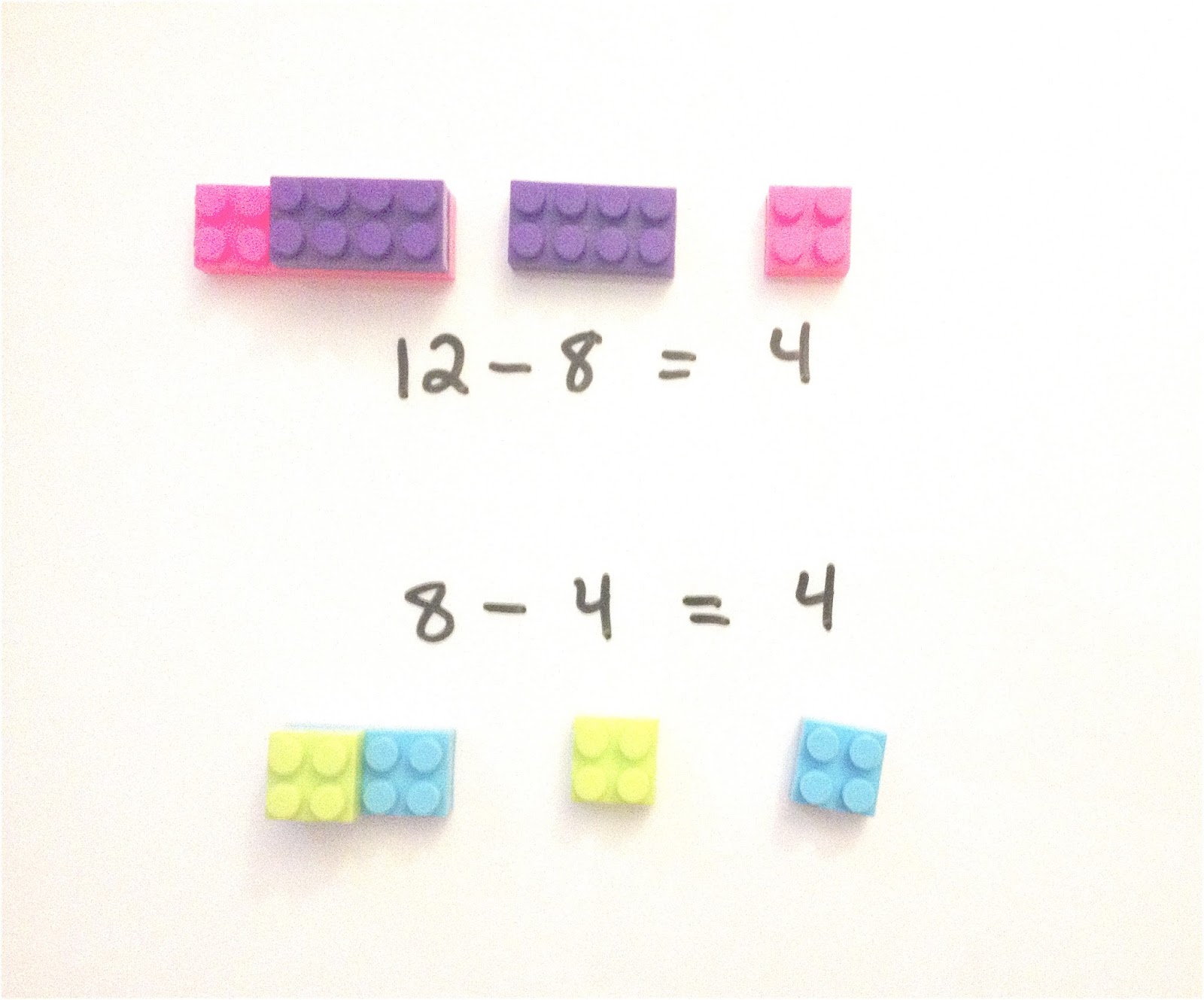


Subtraction – Place one Lego that has fewer pegs on top of another that has more to reveal subtraction concepts.  For example, a 12-peg Lego beneath an 8-peg Lego of the same color that is being subtracted, helps children to put quantities into groups.


Recognizing Patterns – Choose two or three different colors, and have your child create various pattern types.  Or create the pattern yourself and have your child to determine what the pattern is.


Comparing Numbers – Stack up blocks next to each other, and ask your child which one contains more.  Then demonstrate how the greater than/less than symbol indicates the amount as well.


Measuring – Take any toy that your child likes and use Legos to measure them.  Then ask how many Legos long is your toy?


Making Perfect Squares – Line up Legos so that they form multiplication arrays that display perfect squares.  For example, 2 x 2 is 4.  Then have your child to count the pegs represented in the answer.


Multiplication and Division – Use larger Legos or Duplos to show groups.  Three groups of eight make twenty four. Then write out the equation, 3 x 8 = 24.  You could also write out 8 + 8 + 8 = 24, to show that multiplication is repeated addition.


 Counting and Number Matching – This next one works better on bigger blocks, like Lego Duplos.  I used a small dry erase marker to write on the blocks.  They erase well with the wipe of a tissue.  Separate the blocks, write the numbers on them, then have your child to match them up.  This will help them learn to relate the cardinal number to the written number, and to the quantity – represented in the dots.


Putting the Alphabet in Order – Mix up blocks and spread them out, then have your child to put them in order.  Make this activity more fun by having your child sing the alphabet song while playing the game, or race against a timer.


Making Letters – Work with your child to creatively form as many letters as you can with the blocks.


Sentence Structure – Write a simple sentence, like the one below.  Mix up all the words, and have your child to place them in order, to form a complete sentence.

Prefixes – Write the prefix on the smaller block, and the root word on the larger block to demonstrate how the prefix changes the word.


Suffixes – Write the suffix on the smaller block, and the root word on the larger block to demonstrate how the suffix changes the word.


 Subject & Predicate – Write a basic sentence and then choose two large blocks on which to write ‘subject’ and ‘predicate.’ You can do this with nouns and verbs, or if your child is more advanced, use subjects and predicates.  But use the larger blocks to label the parts of the sentence, and smaller blocks to write the words.


Word Families/Rhyming Words – Use one similar color to write a list of rhyming words.  Point out the spelling of these words and point out how they are similar in sound and spelling.  Use the blocks to group them together.


Flocabulary and other Student News Resources


How do we keep students engaged and interested in current events?  Are adult news outlets appropriate for younger viewers?  Do mainstream news outlets keep students attention?  Below I will share some online resources for student news and current events.  Some are created by students, and all are created for them. 

Keeping middle and high school students active and engaged in the content is always something on an educators mind.  One way I would keep my students minds flowing is to start off the week with current events.  This eventually progressed into a conversation, then debate, then outline and finally a persuasive essay.  One resource I used was  CNN Student News which is aimed at grades 7-12.  I loved downloading their podcast each week, because it presented highlights of current events that were quickly summarizes and easily digested by young people in a way that they could both comprehend and respond to.

Another resource for news and current events geared toward middle ans high school students is the PBS News Hour Extra.  This website offers article written by students, videos and even lesson plans for teachers.  The videos have critical thinking questions and are downloadable, which is a plus if your school has an unreliable internet connection.  

For elementary aged students I have found a couple resources that I am using for my children.  Scholastic Student News has articles and videos as well as a print and online magazine.  The target ages for their content is Pre-K through 6th grade.  Many articles and videos are available online for free, and they offer subscriptions for those that want even more content.


Finally, one resource for current events that I am really exited about is the introduction of the Junior version of the week in rap by Flocabulary.  The week in rap has been going strong for the upper grades and I loved it.  So I am happy to see them create content for younger students as well.  Each week they set a few news stories to a beat and turn it into a song.  There are even vocabulary and activity sheets available to download for each song.  Flocabulary has a few free videos on YouTube and offers a free trial.  Check out a sample video below.  


This video covers four topics.  The first is about a young girl entrepreneur who sells delicious lemonade, the second talks about the US Women's Soccer teams, then they cover space exploration and wrap up with the plastic bag ban in Hawaii. 


For further reading on child entrepreneurs check out these tow books: 


For further reading on kids in sports, check out this series from Sports Illustrated:


For further reading on space exploration check out these books: 


For further reading on plastic bags and recycling, check out these books: 


What resources do you use for students news and current events?  Share in the comments below.


Share

Related Posts Plugin for WordPress, Blogger...